Project - 2019
AFS File System
A Unix file system simulation in C - directories, files, and disk block allocation on a virtual disk.
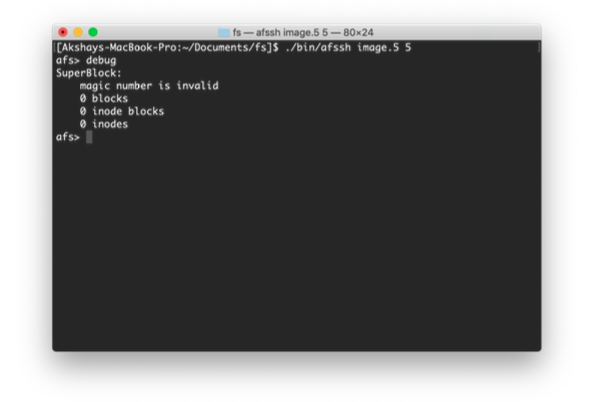
AFS in action - creating directories and files on a simulated disk.
Overview
Understanding file systems
by building one from scratch
AFS is a trivial file system implementation that emulates the core concepts of Unix file systems. It operates on a simulated disk composed of fixed-size blocks, implementing directory trees, file creation, and block allocation - the fundamental operations that underpin every modern operating system.
The project strips away the complexity of real kernel-level file systems to expose the essential algorithms: how directories map names to inodes, how inodes track block pointers, and how free space is managed across a block device.
Language
C
Domain
Systems
Model
Unix FS
Storage
Block Device
Structure
Inodes
Interface
CLI
Architecture
Layers of abstraction
Technical
The mechanics of a file system
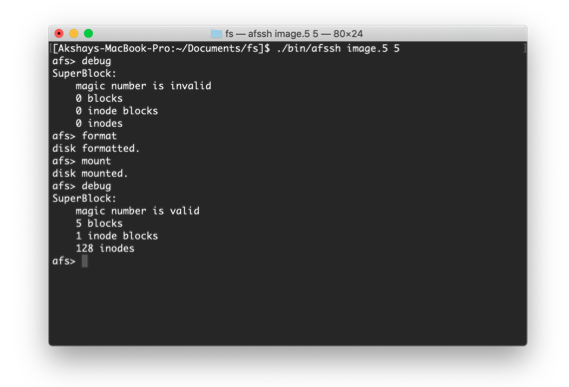
The simulated disk is divided into fixed-size blocks. A superblock tracks file system metadata. Inodes store file attributes and block pointers. Directories are special files that map names to inode numbers. Free space tracking uses a bitmap or free list to allocate and reclaim blocks.
Operations like mkdir, touch, and ls traverse this structure just like their real Unix counterparts - resolving paths component by component, reading directory entries, and following inode pointers to data blocks.